




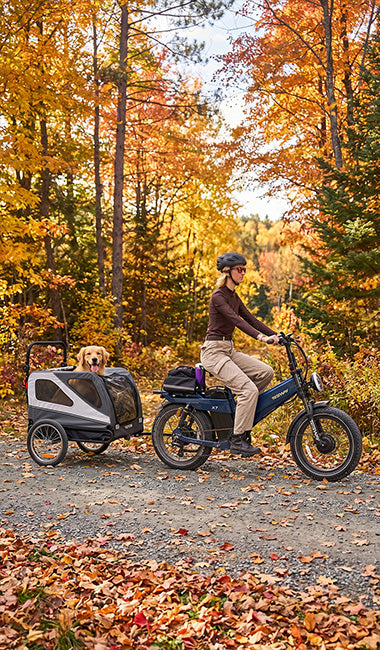
Most road-legal electric bikes in Canada provide motor assistance up to 32 km/h. High power models may reach 50 to 70 km/h, but wattage alone does not decide speed. The controller, battery, rider weight, terrain and provincial rules all affect real-world performance.
What Is the Top Speed of an Electric Bike in Canada?
A standard Canadian electric bike usually provides motor assistance up to 32 km/h. Once the bike reaches that speed, the motor stops adding power.
This does not mean the bike cannot move faster. The rider may continue pedalling or gain extra speed downhill. However, motor assistance above the provincial limit may change how the vehicle is classified.
High performance electric bikes can reach much higher speeds. Models with 2000W, 3000W or 4000W peak power may be capable of 50 to 70 km/h under suitable conditions. These bikes may not qualify as standard electric bicycles on public roads.
| Speed Type | Meaning |
|---|---|
| Assisted speed | The speed at which the motor stops providing power |
| Cruising speed | A speed the rider can maintain comfortably |
| Pedalling speed | Speed produced by the rider after assistance ends |
| Advertised top speed | The highest speed listed by the manufacturer |
| Off-road speed | Full performance used on private land or approved routes |
Motor Cut-Off Speed Is Not the Same as Top Speed
The 32 km/h limit normally controls motor assistance. It does not apply the brakes or stop the wheels.
When the motor cuts out, the rider can still pedal faster. A downhill slope may also carry the bike above 32 km/h.
A stronger motor may reach the cut-off speed faster. It may also hold that speed better on hills or against a headwind. This is why a powerful electric bike can feel much stronger even when its assisted-speed limit is the same as a lower-power model.
For many riders, acceleration and speed maintenance matter more than the final top-speed number.
Electric Bike Speed Rules in Canada
Canada does not currently use one active federal definition for all electric bike road-use rules. Provincial and territorial governments set most operating requirements.
Many provinces still use 32 km/h as the maximum motor-assisted speed. A 500W continuous-power limit is also common.
| Province | Common Standard |
|---|---|
| Ontario | Up to 500W and 32 km/h motor assistance |
| Quebec | Up to 500W and 32 km/h motor assistance |
| Alberta | Up to 500W and 32 km/h |
| British Columbia | Up to 500W and 32 km/h for a standard e-bike |
| Manitoba | Motor power must stop above 32 km/h |
| Saskatchewan | Higher-power cycles may fall under motorcycle rules |
British Columbia also has a light e-bike category. These bikes are limited to 250W and 25 km/h and must use pedal assistance rather than a throttle.
Power and speed are not the only rules. Provinces may also set requirements for rider age, helmets, braking systems and permitted roads.
Municipalities, parks and trail operators can apply additional restrictions. A bike that is legal on one road may not be allowed on a local trail.
A high power electric bike can be sold in Canada without qualifying as a normal bicycle in every province.
How Fast Can Different Electric Bikes Go?
Motor wattage gives a general idea of performance, but it does not create a fixed top speed.
The controller sets how much current reaches the motor. Battery voltage affects speed potential. Motor design, wheel size and software limits also matter.
| Motor Power | Common Use | Possible Unrestricted Speed |
|---|---|---|
| 250W | Light city riding | About 25–32 km/h |
| 500W | Commuting and moderate hills | Often limited to 32 km/h |
| 750W–1000W | Faster acceleration and stronger climbing | About 35–50 km/h |
| 2000W | Heavy loads and dual-motor riding | About 50–60 km/h |
| 3000W | High-performance and off-road riding | About 55–65 km/h |
| 3500W–4000W+ peak | Steep hills and rough terrain | About 60–70 km/h |
These are broad market ranges. They are not guaranteed speeds.
250W Electric Bike Top Speed
A 250W electric bike is usually designed for light commuting and flatter roads. It offers smooth assistance and lower energy use.
Many 250W models assist up to 25 or 32 km/h, depending on the controller and local rules.
This power level works best for lighter loads and moderate riding. It may feel weak on steep hills, especially with cargo or a heavier rider.
500W Electric Bike Top Speed
A 500W motor is common in Canada because it fits the standard used by several provinces.
Most road-ready 500W models stop assisting at 32 km/h. Some unrestricted versions may be capable of more, but their public-road classification may change.
Not every 500W bike performs the same. Torque, controller settings, bike weight and wheel size affect acceleration and climbing.
A well-tuned 500W motor may feel stronger than a poorly matched 750W system.
750W and 1000W Electric Bike Top Speed
A 750W or 1000W motor normally provides stronger acceleration and better hill performance.
Unrestricted models may reach about 35 to 50 km/h. The exact speed depends on voltage, controller settings and motor design.
A higher power motor can also hold speed better when carrying cargo or riding into the wind. It may still be limited to 32 km/h by software.
In several provinces, a motor above 500W may fall outside the standard electric bicycle definition. A lower speed setting does not always solve the power-limit issue.
How Fast Can a 2000W Electric Bike Go?
A 2000W electric bike may use one large motor or two 1000W motors.
Many unrestricted 2000W models are marketed at around 50 to 60 km/h.
A dual motor electric bike mainly improves acceleration, traction and climbing rather than doubling top speed.
A 2000W AWD system can perform better on steep hills, gravel, snow and loose ground. It can also support heavier riders and cargo more effectively.
Using both motors increases battery use. On easier roads, single-motor mode may provide better range.
How Fast Can a 3000W Electric Bike Go?
A 3000W electric bike may use one high-output motor, two 1500W motors or a lower-rated system with 3000W peak power.
Many models list a 3000W electric bike speed of about 55 to 65 km/h.
At this power level, the motor is only one part of the bike. Brakes, tyres, suspension and frame strength become more important.
A 3000W bike is usually heavier than a normal commuter model. The extra motor power and battery capacity increase total weight. This affects handling, storage and stopping distance.
The bike should have brakes and tyres designed for its speed and weight.
How Fast Can a 4000W Electric Bike Go?
High-performance dual-motor bikes can now produce 3500W to 4000W or more at peak output.
Some models list top speeds of 60 to 70 km/h. These bikes are closer to electric mopeds in performance than normal commuter bicycles.
They are designed for strong acceleration, steep climbs and rough terrain. Their full output is better suited to private land or routes where high-powered electric vehicles are permitted.
Tesway offers several models in this category. The Tesway X7 AWD uses a 3600W peak dual-motor system with a listed top speed of about 60 km/h, while the Tesway X7 X9 Ultra reaches 4000W peak power and about 70 km/h. Their full performance should only be used where local rules allow it.
Nominal Power, Peak Power and Combined Power
A large wattage number does not always describe the same type of power.
| Power Term | Meaning |
|---|---|
| Nominal power | Power the motor can maintain for longer periods |
| Peak power | Maximum short-term output |
| Combined power | Total claimed output from two motors |
| Controller input | Electrical power supplied to the drive system |
A bike advertised as 3000W peak may have a much lower continuous rating. Another model may use two motors that provide 3000W combined.
This makes direct comparisons difficult.
A 2000W rated motor should not be compared with a 2000W peak system as though they are identical. The rated system may hold its output for longer.
When comparing electric bikes, check the nominal power, peak power, battery voltage and motor configuration.
Why More Power Does Not Always Mean More Speed
Motor power affects acceleration and load performance, but several other parts control top speed.
Controller and Speed Limiter
The controller decides how much electrical current reaches the motor. It can also stop motor assistance at a programmed speed.
A powerful motor with a 32 km/h limit may not be faster than a smaller motor. It may only reach 32 km/h more quickly.
Battery Voltage
Higher voltage can support faster motor rotation and stronger power delivery.
Common electric bike systems include 36V, 48V, 52V, 60V and 72V.
A higher-voltage battery does not guarantee more speed. The motor and controller must be designed to use it.
Battery capacity is different from voltage. A larger capacity increases available energy and range. It does not automatically increase top speed.
Torque
Torque affects starting power, hill climbing and load support.
For steep hills, cargo or snow, torque may be more useful than a high top speed.
A high-torque bike can lose less speed when the route becomes difficult. It may also accelerate more smoothly with a heavy load.
Rider and Cargo Weight
More weight requires more power.
A heavier rider or large cargo load can reduce acceleration and make it harder to reach the advertised speed.
Weight also increases braking distance. High-power bikes need suitable brakes for the total load.
Tyres and Wheel Size
Fat tyres improve grip on snow, sand and loose trails. They also create more rolling resistance.
Narrower road tyres usually roll more easily on pavement. They may help the bike use less energy at the same speed.
Wheel size also affects performance. Larger wheels cover more distance per rotation, while smaller wheels may provide stronger low-speed acceleration.
Terrain and Wind
A flat road allows the bike to reach a higher speed than a steep climb.
A strong headwind can also reduce speed. At higher speeds, wind resistance becomes a major source of energy use.
Manufacturer speed tests may use a light rider, full battery, flat road and calm weather. Daily riding conditions are often less favourable.
How Canadian Winter Affects Speed
Cold weather can reduce battery output and range. The programmed speed limit may remain the same, but the bike may accelerate more slowly.
Snow and slush add rolling resistance. Low tyre pressure can make the bike even less efficient.
Winter clothing also increases wind resistance. A rider may need more motor power to maintain the same speed.
Fat tyres can improve grip on snow, but they also require more energy. Studded tyres can improve control on ice, although they may reduce efficiency.
In winter, control is more important than maximum speed. Riders should allow more braking distance and avoid sudden acceleration on slippery surfaces.
How Top Speed Affects Range
Higher speed uses more battery power.
The motor must work harder against wind and rolling resistance. Riding at 50 km/h uses far more energy than riding at 25 km/h.
Hard acceleration also reduces range. Dual-motor mode, full throttle and steep hills increase battery use.
A long range electric bike in Canada can travel farther with a larger battery, but higher speed still increases energy use.
For longer rides, lower assistance levels are more efficient. Dual-motor mode is best saved for hills, loose ground or heavy loads.
Advertised range figures should also be treated as estimates. Rider weight, temperature, terrain and assistance level can change the result.
Is 32 km/h Fast Enough for Canadian Riders?
For most city and suburban trips, 32 km/h is enough.
Traffic lights, intersections, shared paths and parked cars often reduce the average speed. A higher top speed may save little time on a short commute.
Riders on hills, gravel or snow may benefit more from torque and traction than from extra speed.
Higher power is also useful for cargo and heavier riders. In these cases, the main benefit is keeping the bike moving under load.
For normal city riding, smooth acceleration and reliable braking are often more valuable than a 60 or 70 km/h top speed.
What Happens If an Electric Bike Exceeds Provincial Limits?
A bike that exceeds local power or speed limits may no longer qualify as an ordinary bicycle.
It may fall under moped, motorcycle or another motor-vehicle category. Licensing, registration, insurance and equipment rules may then apply.
A speed limiter does not always make a high-power bike road compliant. Some provinces also limit continuous motor output.
Before buying a 2000W or 3000W model, check the rules in your province. Municipal bylaws and trail rules should also be reviewed.
Private land does not always mean unrestricted use. The property owner must allow the vehicle, and local rules may still apply.
Should You Remove the Speed Limiter?
Removing the speed limiter can change the bike’s legal classification.
It may also place more stress on the motor, controller, battery, brakes and tyres. Range will usually fall because the bike uses more power at higher speeds.
Changing wheel-size or controller settings can make the speedometer inaccurate.
A bike designed around a lower assisted speed may not have the brakes, suspension or frame stability needed for much higher speeds.
Full-power settings should only be used where the vehicle is permitted and the route is suitable.
Conclusion
Most Canadian road e-bikes assist up to 32 km/h, while high-power models can reach 50 to 70 km/h. Motor wattage mainly improves acceleration, climbing and load support. Compare rated power, battery voltage, brakes and local rules instead of choosing a bike by top speed alone.
FAQs
Can an Electric Bike Go Faster Than 32 km/h in Canada?
Yes. It may go faster through pedalling, downhill momentum or a high-performance drive system. Motor assistance above 32 km/h may affect its legal classification.
How Fast Can a 500W Electric Bike Go?
Many Canadian 500W models stop assisting at 32 km/h. Unrestricted capability depends on the motor, battery and controller.
How Fast Can a 2000W Electric Bike Go?
Many unrestricted 2000W models reach around 50 to 60 km/h. Dual motors mainly improve acceleration, traction and climbing.
How Fast Can a 3000W Electric Bike Go?
Many 3000W models are marketed at about 55 to 65 km/h. Actual speed depends on voltage, controller settings and whether the power figure is rated or peak.
Does a Bigger Battery Make an Electric Bike Faster?
Not by itself. A larger battery mainly increases range. Voltage, motor design and controller settings have a greater effect on top speed.
Is a High Power Electric Bike Legal in Canada?
It may be legal to own or use in certain places, but it may not qualify as a standard bicycle on public roads. Provincial and local rules apply.

