




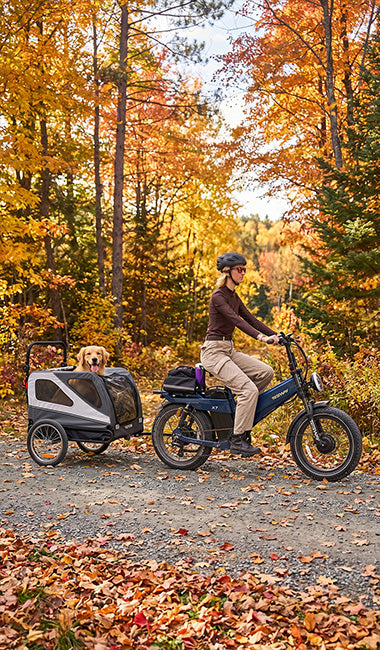
A throttle assist electric bike lets you activate the motor from a handlebar control. It can make starts, hills and loaded rides easier, especially when used with pedal assist.
What Is a Throttle Assist Electric Bike?
A throttle assist electric bike uses a handlebar control to activate the motor without requiring continuous pedalling. Depending on the design, you press a thumb lever or turn part of the grip to control the power.
Many electric bikes include both throttle assist and pedal assist. Pedal assist responds when you pedal, while the throttle gives you direct control through your hand. You might use the throttle for a smooth start at an intersection, then switch to pedal assist once moving.
A throttle does not automatically make an electric bike faster. Motor power, controller settings and the assisted speed limit still determine performance. Some throttles work from a complete stop, while others only become active after the bike begins moving.
How Does Throttle Assist Work?
When you press or turn the throttle, it sends a signal to the bike’s controller. The controller manages how much power goes from the battery to the motor, making it a central part of the electric bike power system. A small input should provide light assistance, while a larger input should increase the power.
The quality of this response is known as throttle modulation. A well-tuned system builds power smoothly and gives the rider useful control at low speed. A poorly tuned throttle may feel delayed or deliver too much power at once.
The motor should stop when you release the throttle. Many electric bikes also use brake cut-off sensors, which stop motor output when a brake lever is pulled. Some systems limit throttle output in lower assist modes, while others provide the same output in every mode.
Common Types of E-Bike Throttles
Thumb Throttle
A thumb throttle uses a small lever beside the grip. It works well for short bursts, but holding it for long periods may cause fatigue. Its position should not interfere with the brake, shifter or display buttons.
Twist Throttle
A twist throttle activates the motor when you rotate the grip. It can provide continuous control, but rough roads or wrist movement may add power unintentionally. Smooth spring return is important.
Half Twist Throttle
A half twist throttle rotates only part of the grip. The fixed section gives the rider a stable hand position while the rotating section controls the motor.
No type is best for everyone. Hand size, winter gloves, handlebar layout and terrain all affect comfort.
Throttle Assist vs Pedal Assist
Throttle assist and pedal assist both use the motor, but they activate it differently.
| Feature | Throttle Assist | Pedal Assist |
|---|---|---|
| Motor activation | Hand control | Pedalling |
| Pedalling required | Not always | Yes |
| Starting from a stop | Usually easier | May require an initial pedal stroke |
| Riding feel | Direct motor control | Closer to a regular bicycle |
| Battery use | Higher when used continuously | Usually more efficient |
| Best use | Starts, hills and short breaks | Continuous riding |
Pedal assist is usually better for steady travel because it keeps the rider involved and shares the work with the motor. The choice between pedal assist and throttle control often depends on the rider’s preferred effort, range and starting support.
Throttle assist is most useful during short moments that interrupt normal pedalling. It can help the bike begin moving, support a hill start or provide temporary relief when the rider is tired.
For many Canadian riders, the most practical setup is responsive pedal assist supported by a smooth throttle.
When Is Throttle Assist Most Useful?
Starting From Traffic Lights
City riding often involves repeated stops. Starting a heavier electric bike while watching traffic and finding the pedal can feel awkward. A light throttle input can move the bike forward and help establish balance before pedalling.
Restarting on a Hill
Hill starts require balance and force at the same time. Throttle assist can provide the first push and reduce wobbling. Once moving, a suitable gear and pedal assist usually give better control and efficiency.
Carrying Cargo
Groceries, work equipment and other loads increase the effort needed to start. Controlled throttle power can help the bike move without a hard first pedal stroke. Cargo should still be secured and balanced.
Managing Fatigue
After a long ride, strong headwind or several climbs, the rider may need a short break. Throttle assist can maintain movement until the rider is ready to pedal again.
Low-Speed Manoeuvring
A smooth throttle can help in parking areas, garages and tight spaces. Low-speed control requires a small, predictable amount of power. If the throttle feels abrupt, turn off the motor and move the bike by hand.
Benefits and Limitations of Throttle Assist
The main benefit of throttle assist is immediate support. You do not need to wait for a pedal sensor to detect movement. This can make an electric bike easier to start on hills, in traffic or with a heavy load.
A throttle may also help riders who find repeated starts difficult. However, it cannot replace a bike that fits properly. Frame size, riding position, gearing and brake reach still affect control.
The main limitation is energy use. When the motor provides all the driving force, the battery works harder. Frequent high-speed throttle use can reduce range faster than moderate pedal assist.
Abrupt power can also feel unstable on gravel, wet pavement, snow or ice. Riders must avoid accidental activation while mounting, parking or walking beside the bike. The throttle and electrical connections also need to remain clean and responsive.
Does Throttle Assist Reduce E-Bike Range?
Throttle use can reduce range, but the difference depends on how it is used. A few seconds at traffic lights will have a much smaller effect than travelling several kilometres without pedalling.
Energy use rises with speed, hills, wind and total weight. Soft tires, heavy cargo and frequent stops also increase consumption. Cold weather can further reduce available battery capacity.
Battery size is often shown in watt-hours, or Wh. A larger Wh rating provides more stored energy, but it does not guarantee a fixed distance. Real range still depends on speed, assist level, terrain, temperature and rider input.
For better range, use the throttle mainly for starts and short difficult sections. Once moving, continue with pedal assist.
Throttle Assist in Canadian Riding Conditions
Cold temperatures can reduce usable battery capacity, so winter range may be lower than summer range. Keep the battery dry and store or charge it at a moderate indoor temperature when permitted by the manufacturer.
Snow and ice require gentle power. A sudden burst can break tire traction, especially while turning or climbing. Start with low power, keep the bike upright and avoid sharp steering. Lower pedal assist is often better for steady movement, while the throttle can provide a brief push when starting.
Winter gloves also affect control. A thick glove may make a thumb lever harder to feel, while a twist throttle may move when the rider grips the bar tightly. Test the controls with your usual gloves. You should still be able to reach the brakes and shifter immediately.
Salt, water and road grime can collect around electrical connections. Regular cleaning and dry storage help protect the throttle, display and wiring.
Are Throttle Assist Electric Bikes Legal in Canada?
Canada does not have one simple throttle rule covering every province, road and trail. Transport Canada states that the former federal definition of a power-assisted bicycle stopped being the benchmark for manufacturing and importing e-bikes on February 4, 2021. Provincial and local rules therefore need to be checked for road use.
Requirements can differ by location and e-bike category. British Columbia distinguishes between standard and light e-bikes. Its current rules allow a throttle on a standard e-bike, while a light e-bike must use pedal assistance and cannot have a throttle. Québec states that electric assistance may be activated by the pedals or an accelerator control, provided the bicycle meets provincial public-road requirements.
Trail access is separate from road legality. Parks Canada pages for Jasper and La Mauricie state that an e-bike with an accelerator is not treated as a pedal assist e-bike and may be ridden on roads rather than those cycling trails.
Check the rules for your province, municipality and specific park or trail. A bike allowed on a public road is not automatically permitted on every shared path or recreational trail.
What to Check Before Buying a Throttle Assist E-Bike
Start with throttle response. Apply a small amount of input and check whether the bike moves smoothly. Power should build predictably. A throttle that feels delayed, jerky or too strong at low speed will be harder to manage.
Confirm whether it works from a full stop or only after the bike begins moving. This changes how useful it will be on hills and at intersections.
Test the brake cut-off system. With the bike supported safely, apply the throttle lightly and pull a brake lever. Motor output should stop. The throttle should also return to neutral as soon as you release it.
Check the handlebar layout. You should be able to reach the throttle, brake and shifter without stretching or changing your grip. Try the controls while wearing your usual winter gloves.
Do not judge the motor only by advertised peak output. Rated motor power and electric bike speed limits in Canada provide a clearer picture of how the bike may be classified and where electrical assistance must stop. These figures are more useful when comparing a bike with provincial requirements. British Columbia’s current categories, for example, use continuous motor power and assisted speed rather than peak figures.
Check battery capacity in watt-hours and consider your route. Frequent throttle use, steep hills, high speed and winter temperatures require more energy. A larger battery may suit longer rides, but it also adds weight.
Finally, consider the whole bike. Strong brakes, suitable tires, stable handling and correct frame size matter as much as the throttle. Instant power is useful only when you can control and stop the bike confidently.
Who Should Choose a Throttle Assist Electric Bike?
A throttle assist electric bike can suit commuters who stop often, riders who regularly start on hills and people who carry groceries or work equipment. It may also help riders who want occasional relief during longer trips without giving up pedal assist.
The feature is less important for riders who mainly want exercise, travel short distances on flat roads or prefer a lighter bicycle. It may also be a poor match for someone who mainly uses trails that restrict accelerator-equipped e-bikes.
Choose based on your route. A smooth throttle may add real value in busy traffic or hilly areas. On a quiet, flat route, responsive pedal assist may already provide everything you need.
Is Throttle Assist Worth Having?
Throttle assist is worth having when it solves a real riding problem. It can make starts easier, reduce strain on hills and help a loaded bike move smoothly. The best use is usually short and controlled rather than continuous.
For many riders, a balanced system is more useful than maximum throttle power. Look for smooth response, reliable return, brake cut-off and a comfortable control position. Combine the throttle with efficient pedal assist, suitable gearing and strong brakes.
Conclusion
For Canadian riders who cover longer distances or regularly face hills, gravel and uneven roads, battery capacity and traction matter as much as throttle control. Tesway long range e-bikes, including the Tesway X5 AWD and Tesway X7 AWD, combine dual motor AWD, a 52V 60Ah battery, full suspension and 20 × 4.0 inch fat tires. Both offer up to 200 miles of pedal assist range, giving riders more battery reserve for longer routes and colder conditions. The X5 uses a step-through frame for easier mounting, while the Tesway X7 has a traditional step over design. Throttle assist also provides extra support when starting on hills, carrying loads or moving through stop-and-go traffic.
FAQs
Can a Throttle E-Bike Move Without Pedalling?
Many throttle-equipped electric bikes can move without continuous pedalling. Some work from a complete stop, while others require the bike to begin moving first. The behaviour depends on the controller, riding mode and manufacturer settings.
Does Throttle Assist Use More Battery?
Continuous throttle use usually consumes more energy because the motor supplies most or all of the driving force. Short use for starts or hills has a smaller effect. Speed, terrain, weight, temperature and tire pressure also affect range.
Is a Thumb Throttle Better Than a Twist Throttle?
A thumb throttle can be easy to use in short bursts and may reduce accidental wrist input. A twist throttle can provide natural, continuous control. The better choice depends on comfort, handlebar layout, gloves and riding conditions.
Are Throttle Electric Bikes Legal Everywhere in Canada?
No single rule covers every province and riding location. Provincial vehicle definitions, municipal path rules and park restrictions can differ. Confirm the bike’s specifications and check the rules for the roads and trails you plan to use.

