




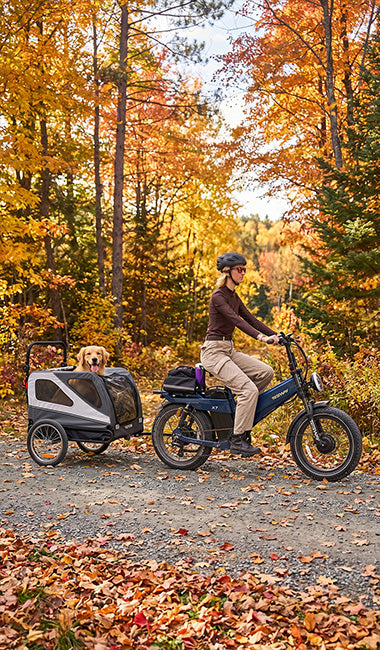
A 40 km daily commute is within reach for many electric bikes, but the battery needs enough reserve for hills, cold weather, higher assistance and gradual capacity loss. For most riders, 750Wh is a practical starting point, while 900Wh to 1,200Wh provides more dependable year round range in Canadian conditions.
Battery Size Guide for a 40 km Commute
The right battery depends first on whether 40 km means the entire daily round trip or only one direction.
| Commute distance | Riding conditions | Minimum practical capacity | More comfortable choice |
|---|---|---|---|
| 40 km total per day | Flat roads, mild weather and regular pedalling | 500–625Wh | 750Wh |
| 40 km total per day | Hills, winter, heavier rider or high assistance | 750Wh | 900–1,200Wh |
| 80 km total per day | Moderate conditions | 1,000Wh | 1,200–1,500Wh |
| 80 km total per day | Winter, hills or no workplace charging | 1,500Wh | 1,800Wh or more |
These figures are planning estimates rather than guaranteed range numbers. Speed, assistance level, temperature, rider weight, tire pressure and route elevation can all change how much energy the bike uses.
Start With the Total Daily Distance
A “40 km commute” can describe two very different journeys.
A rider travelling 20 km to work and 20 km home needs enough energy for 40 km per day. A rider travelling 40 km each way needs enough for an 80 km daily journey.
That difference can double the required battery capacity.
You should also consider whether charging is available at work. A dependable workplace outlet can divide the journey into two shorter rides. Without workplace charging, the battery must cover the entire return trip while keeping enough reserve for headwinds, detours, cold temperatures or an unexpectedly demanding ride.
Always calculate the distance the bike must cover between charges, not just the distance of one section of the journey.

Compare Batteries in Watt Hours
Electric bike batteries are commonly advertised using voltage and amp hours. These figures are useful, but watt hours provide the clearest comparison of total stored energy.
Use this calculation:
Voltage × amp hours = watt hours
For example:
| Battery rating | Energy capacity |
|---|---|
| 36V 14Ah | 504Wh |
| 48V 15Ah | 720Wh |
| 48V 20Ah | 960Wh |
| 52V 20Ah | 1,040Wh |
| 52V 60Ah | 3,120Wh |
A 48V 15Ah battery and a 36V 20Ah battery both store about 720Wh, even though their voltage and amp hour ratings look different.
This is why watt hours are more useful when comparing batteries for the same commute. They show how much total energy the battery can hold rather than only one part of its electrical specification.
Estimate How Much Energy the Commute Uses
There is no single energy consumption figure that applies to every electric bike. However, the following planning ranges can help estimate the capacity required.
| Riding conditions | Estimated consumption |
|---|---|
| Efficient riding with active pedalling | 10–12Wh per km |
| Normal mixed commuting | 13–17Wh per km |
| High assistance, hills, cold weather or heavy load | 18–25Wh per km |
A lightweight commuter on flat roads may stay near the lower end. A heavy fat tire bike using high assistance or frequent throttle will normally consume more energy. The differences between pedal assist and throttle can also affect overall battery use.
Your own riding data will be more accurate once you have completed the route several times. Until then, calculating from the middle or upper end provides a safer starting point.
Calculating Battery Size for a 40 km Round Trip
Suppose the bike uses an average of 15Wh per km.
40 km × 15Wh = 600Wh
A 600Wh battery could theoretically complete the route, but choosing a battery that only matches the calculated requirement leaves little room for changing conditions.
Adding a 25 per cent reserve gives:
600Wh × 1.25 = 750Wh
This is why a battery of around 750Wh is a practical target for a typical 40 km daily round trip.
Now consider a more demanding route using approximately 20Wh per km:
40 km × 20Wh = 800Wh
With the same reserve:
800Wh × 1.25 = 1,000Wh
For a hilly route, winter commuting, a heavier rider or regular use of high assistance, a battery close to 1,000Wh offers a safer margin.

Is a 500Wh Battery Enough?
A 500Wh battery may cover 40 km under favourable conditions. The rider would need to pedal consistently, use moderate assistance and avoid spending too much energy on steep hills or repeated acceleration.
The important question is not whether 500Wh can ever travel 40 km. It is whether it can complete the same route reliably every working day.
A 500Wh battery leaves limited reserve for:
-
Cold temperatures
-
Strong headwinds
-
Route changes
-
Gradual battery ageing
-
Additional cargo
-
Repeated stops and starts
-
Higher assistance when the rider is tired
It may still be suitable when the route is flat, the bike is efficient and charging is available at work. For year round commuting without workplace charging, however, it can be a tight fit.
Why 750Wh Works for Many Commuters
A 750Wh battery provides a useful middle ground. It is large enough for many 40 km round trips without adding the cost and weight of a much larger battery.
For a rider using 15Wh per km, the estimated journey consumes around 600Wh. That leaves approximately 150Wh of rated capacity before accounting for normal differences between theoretical and real world performance.
However, 750Wh should not automatically be treated as the ideal battery for every season. A difficult Canadian winter route may still justify moving closer to 1,000Wh.
When a Larger E-Bike Battery Is Worth It
A larger battery becomes useful when several range reducing conditions occur together.
Consider a heavier rider carrying work equipment on a fat tire electric bike. If the route also includes long hills and frequent stops, the bike may use considerably more energy than a lightweight commuter travelling on flat pavement.
The same applies to riders who depend heavily on motor assistance. Higher assistance reduces the rider’s physical effort, but the additional energy must come from the battery. Frequent throttle use, quick acceleration and maintaining higher speeds can increase consumption further.
A battery between 900Wh and 1,200Wh is worth considering when:
- The commute includes long or steep hills
- The rider regularly carries cargo
- Most of the journey uses high assistance
- The bike has wide tires and a heavy frame
- Charging at work is not dependable
- The bike will be used throughout the Canadian winter
The additional capacity does more than increase maximum range. It creates a larger operating margin, which can make the bike more dependable across changing weather and riding conditions.
Canadian Winter Changes the Calculation
Cold weather can temporarily reduce the energy available from a lithium ion battery. A battery that comfortably covers 40 km during summer may reach the end of the same journey with much less charge during winter.
Instead of relying on one fixed winter reduction percentage, calculate from the more demanding end of the energy use range and leave a larger reserve.
Charging temperature also matters. Battery manufacturers commonly require lithium ion e-bike batteries to be charged above freezing. Bosch specifies a charging range of 0°C to 40°C and recommends charging near room temperature. Shimano also lists 0°C to 40°C for several of its battery systems.
After riding in freezing conditions, bring a removable battery indoors and allow it to warm before charging. Bosch advises storing and charging an e-bike battery at room temperature during cold weather.
For a 40 km winter commute, a battery that is only just sufficient in summer may not provide a comfortable margin. Moving from 600Wh to 750Wh, or from 750Wh to approximately 1,000Wh, can make the journey more predictable.
How Hills Affect Battery Needs
Climbing requires more energy than maintaining speed on level ground. The effect becomes greater when the rider, bicycle and cargo create a high combined load.
A short hill may not change the daily calculation very much. Several kilometres of sustained climbing can make a noticeable difference.
Most electric bicycles also cannot recover enough energy while descending to compensate for the power used during the climb. A route with significant elevation should therefore be calculated closer to 18–22Wh per km rather than the lowest efficiency estimate.
At 20Wh per km:
40 km × 20Wh = 800Wh
After adding a reserve, the practical battery target is approximately 1,000Wh.
Riders should also use suitable mechanical gears rather than relying only on motor assistance. Starting a steep climb in a high gear can place unnecessary load on the motor and consume more battery energy.
Rider Weight and Cargo Also Matter
The motor must move the combined weight of the bike, rider, battery, clothing, locks, bags and cargo. Since electric bike weight in Canada varies by frame, battery and tire size, the bike itself should also be included in the range calculation.
A small difference in weight may have little effect on flat roads at a steady speed. It becomes more important during acceleration and climbing.
A commuter who carries groceries occasionally may not need a larger battery. Someone who regularly carries tools, deliveries, camping equipment or another heavy load should calculate the required capacity around the loaded bike.
A larger battery can support the additional demand, but it also adds weight. The goal is not simply to buy the largest battery available. It is to choose enough capacity for the loaded route while keeping the bike practical to ride, store and transport.
What About a 40 km Commute Each Way?
A 40 km one way commute creates an 80 km daily journey.
Using a moderate estimate of 15Wh per km:
80 km × 15Wh = 1,200Wh
Adding a 25 per cent reserve produces a target of:
1,500Wh
Under more demanding conditions at 20Wh per km:
80 km × 20Wh = 1,600Wh
With a reserve, the rider may need approximately 2,000Wh.
Workplace charging changes the calculation. When the battery can be charged safely during the working day, each 40 km section can be considered separately.
Without workplace charging, a standard 500Wh or 750Wh battery is unlikely to provide a comfortable daily margin for an 80 km route.
Do You Need a Very Large Battery?
A battery above 1,500Wh is more than most riders need for a basic 40 km round trip. However, long range e-bikes for Canadian riders often use larger batteries to support extended commutes, heavy loads and demanding terrain.
The Tesway X5 AWD and X7 AWD use a 52V 60Ah battery, equal to approximately 3,120Wh. Both are listed with up to 320 km of pedal assist range and an 8A fast charger. Actual range depends on assistance level, temperature, terrain, rider weight and riding speed.
That capacity is far beyond the minimum required for an ordinary 40 km commute. Its main advantage is the amount of reserve available for longer routes, winter conditions, hills and riders who prefer not to recharge after every journey.
A very large battery is not automatically the right choice for everyone. It normally increases bike weight and purchase cost. Riders who need to carry the bike upstairs or load it onto a vehicle should consider those practical limitations as well.
Do You Need Workplace Charging for a 40 km Commute?
Workplace charging is usually unnecessary for a 40 km daily round trip when the bike has a 750Wh or larger battery. It becomes more useful for an 80 km daily journey or when winter, hills and high assistance increase energy use.
The Tesway X5 AWD and Tesway X7 AWD use a 52V 60Ah battery with an 8A rapid charger. Charging a nearly empty battery to full takes approximately 8 to 9 hours, while a partial recharge requires less time.
Their 3,120Wh capacity also means most riders would not need to charge at work after every 40 km journey.
How to Choose the Final Capacity
For a 40 km total daily commute, start around 750Wh. Move closer to 900Wh or 1,000Wh when the route includes hills, winter temperatures, high assistance or a heavy load.
For a 40 km one way commute, consider 1,200Wh to 1,500Wh when charging is available at work. Without workplace charging, approximately 1,500Wh to 2,000Wh provides a more realistic starting range.
Do not choose the battery from a manufacturer’s maximum range claim alone. Compare capacity in watt hours, calculate the full distance between charges and review different electric bike options for Canadian riders before selecting a model.
Conclusion
For most 40 km round trip commutes, 750Wh offers a sensible balance of range and battery size. Choose closer to 1,000Wh for winter, hills, heavier loads or frequent high assistance. An 80 km daily journey requires substantially more capacity unless the battery can be charged safely and reliably at work.
FAQs
How many watt hours do I need for a 40 km e-bike ride?
Most riders should plan for approximately 600Wh to 1,000Wh, depending on terrain, temperature, assistance level and load. A battery around 750Wh is a practical starting point for moderate conditions.
Can a 500Wh battery travel 40 km?
Yes, under efficient conditions. However, it may leave little reserve for hills, cold weather, heavy loads or high assistance, making it less dependable for year round commuting.
Is a 1,000Wh battery too large for commuting?
Not necessarily. A 1,000Wh battery can be useful for Canadian winter riding, hilly routes, heavier bikes or riders who cannot charge at work.
Do I need to charge an e-bike after every 40 km ride?
Not always. It depends on battery capacity and energy consumption. A smaller battery may need frequent charging, while a large battery can often complete several 40 km journeys before requiring a full recharge.
How long does a Tesway electric take to charge?
The X5 AWD and X7 AWD use an 8A charger with a 52V 60Ah battery. A basic calculation suggests around 7.5 hours before charging losses and the slower final stage are considered. The X9 Ultra is officially listed at about eight hours.

